Tuesday, November 30, 2010

Bodybuilding - The Body As Art

I came across an interesting exhibit that was shown at the New York's Whitney Museum in the late 1970s. This exhibit was unlike any other before.  It was bodybuilders flexing on a revolving platform in front of thousands of spectators.

This was a new concept that suggested the idea that bodybuilders were much like sculptors in the way that that "constructed" there bodies.  Even more interesting, Arnold Schwarzenegger was a "piece" in this "exhibit".  The author of a book called Pumping Iron, which was eventually made into a movie by the same name, was quoted as saying:

"The body itself is an art medium: malleable, capable of being aesthetically dominated and formed the way clay is by a potter."

(Quote taken from: http://sportsillustrated.cnn.com/vault/article/magazine/MAG1091158/index.htm)

Sunday, November 21, 2010

Protest/Political Art

After reading the Guerrilla Girls excerpt, I started thinking about other kinds of political and protest public art that have made an impact on the world, and are quite recognizable today.

For the most part, political public art is in the form of posters, or it is associated with a particular figure or image, as in the Vietnam war with certain photographs.  One interesting political piece of art that has been around for a while, and has even been used in different situations is the image of Che Guevara.


This image is familiar to most people today.  Che Guevara was a prominent figure in the Cuban Revolution, yet has been used for different purposes today.  Protest bands, like Rage Against the Machine, have associated his image with their band.  This is ironic because the band placed his image on a T-shirt to sell, and fuel a capitalist economy, while Che Guevara was a supporter of communism.

Different forms of political and protest artwork exist today.  The interesting thing to think about, however, is if they will carry the same meaning decades from now, or be used for an entirely different purpose.

Sunday, November 14, 2010

Titian Museum Visit

I went to see the Titian exhibit on Wednesday.  It was very interesting.  Initially, it is not what I anticipated to see because we had been talking about the "white cube" in class.  The Titian exhibit had red walls, instead of white, and all of the paintings, or at least the biggest ones, were framed in gold frames.  This created a different feel than the neutral "white cube" feel created in the modern art section of the high museum.  The red walls, and gold frames made the section of the museum seem more like a palace than a modern museum.  This however leant itself well to the paintings because they were originally painted to be seen in grand, palace-like homes or in churches.  This was an interesting visit to see a contrast between the "white cube" and other methods of displaying artwork.


Tuesday, November 9, 2010

Inside the White Cube

The reading for this Tuesday presents some interesting perspectives on the idea of museums, and how they both present, and interact with art.  One interesting concept that was brought up was the difference between a mural that is permanently fixed on a certain wall, and a painting that is merely hung on a wall, that can be moved around.  A quote from the text is on page 18 "a painted wall is replaced by a piece of portable wall."  This quote brings up the idea that artwork is merely a piece of the wall, yet the idea of portable art is different than in older times.  Art for the most part was permanently fixed in a church or a wealthy person's home.  The new idea that certain art has no permanent "home."

This also brings to light the idea of modern museums that supposedly present every kind of art in an unbiased way that does not add, nor take away from the art.  This is the image of modern museums that we have, the so-called "white cube."  Yet, as the reading points out, the supposed "impartial" museum can have a subliminal effect on the viewers, simply by how the painting is hung, or how the wall is designed.  This makes the idea of a neutral way of presenting all forms of art extremely difficult, and it begs the question:  are certain kinds of art even meant to be presented outside of their original place of creation?

Saturday, November 6, 2010

Duncan - The Art Museum as a Ritual

This reading brings up a few interesting points about museums themselves.  Museums, as we know them today, are relatively new compared to some of the art that they house.  Art was typically, in the past, housed in the homes of the upper-class, or in religious buildings.  It is interesting to note how a large number of famous museums tend to either look like religious buildings, or the homes of extremely wealthy people.

This all adds to the "ritual" of going to a museum.  The entrance into a grand building, looking at perfectly preserved works of art that may be hundreds of years old.  Everyone in the building also remains relatively quiet because of both the set of "rules" that one follows in a museum, and because of the aura of the magnificent art that is on display.

Going to a museum is most certainly an experience, and much like going to a concert is much more impressive than listening to a recording, going to the museum is much more impressive than looking at pictures of art online.


Friday, November 5, 2010

Halloween, Sandcastles, and the Impermanence of Art

The more that I search for art throughout the year, the more I realize that there are an extremely wide variety of art forms that are transient.  The majority of art that we encounter, particularly as a child, is temporary art.

Costumes for Halloween are perfect examples of temporary art.  People spend hours, even days preparing their Halloween costumes, and sometimes there is not even a record of this costume a few days later.  Another example directly relating to Halloween is pumpkin carving.  This is an interesting art form that most people have taken part in, but there are a number of experts who make extremely complex art out of a pumpkin.  Yet, no matter how impressive the art, it can at best be saved through photography.

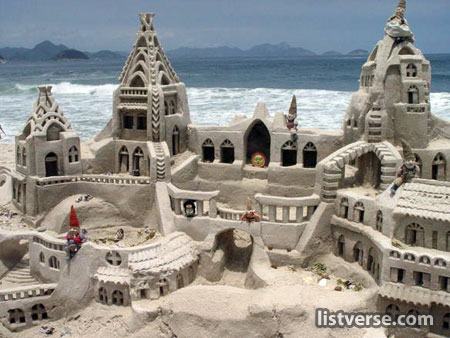
Another form of temporary art that we encounter as children is the making of sandcastles.  Almost every child at one point tries to make the most impressive sand castle they can at the beach, and they try their best to fend off the ocean as the tide rises, but no matter what, the sand castle is not preserved through the next day.  In addition, much like pumpkin carving, their are expert "sand sculptors" but their art can also only be preserved through photography.