Sunday, December 5, 2010
Alex Grey
Alex Grey is an artist who produces are unlike any other I have seen before. He produces spiritual and psychedelic art that is very intriguing. He has produced artwork to be used in albums for a number of musicians including The Beastie Boys, Tool, and Nirvana. His artwork makes use of multiple perspectives at the same time, much like that of the cubist movement, as well as making use of symmetrical optical illusions. He does this all while making use of a wide array of colors and perspective techniques, making his art mesmerizing. This also makes the intended subject sometimes ambiguous, which might be Grey's intention.
Saturday, December 4, 2010
Technology as Art
As technology gets more and more advanced, we tend to associate certain designs and colors with "new" and more advanced technology. What is even more interesting is how these same characteristics eventually make the same technology look extremely outdated. Think of an old apple computer:
At the time, this cutting edge technology with sharp angles, and an off white-ish color made it look extremely hi-tech. These features now however, are associated with the old technology. For example, look at a new apple computer:
This is very different to the previous image. With much more rounded shapes, even in the mouse, and a silver color, instead of an off white, this looks much more "new" to us as consumers, instead of the characteristics associated with the older apple computers. This is interesting to think about with the color choice, and shape choice in relation to how a computer might sell.
Tuesday, November 30, 2010
Bodybuilding - The Body As Art
I came across an interesting exhibit that was shown at the New York's Whitney Museum in the late 1970s. This exhibit was unlike any other before. It was bodybuilders flexing on a revolving platform in front of thousands of spectators.
This was a new concept that suggested the idea that bodybuilders were much like sculptors in the way that that "constructed" there bodies. Even more interesting, Arnold Schwarzenegger was a "piece" in this "exhibit". The author of a book called Pumping Iron, which was eventually made into a movie by the same name, was quoted as saying:
"The body itself is an art medium: malleable, capable of being aesthetically dominated and formed the way clay is by a potter."
(Quote taken from: http://sportsillustrated.cnn.com/vault/article/magazine/MAG1091158/index.htm)
This was a new concept that suggested the idea that bodybuilders were much like sculptors in the way that that "constructed" there bodies. Even more interesting, Arnold Schwarzenegger was a "piece" in this "exhibit". The author of a book called Pumping Iron, which was eventually made into a movie by the same name, was quoted as saying:
"The body itself is an art medium: malleable, capable of being aesthetically dominated and formed the way clay is by a potter."
(Quote taken from: http://sportsillustrated.cnn.com/vault/article/magazine/MAG1091158/index.htm)
Sunday, November 21, 2010
Protest/Political Art
After reading the Guerrilla Girls excerpt, I started thinking about other kinds of political and protest public art that have made an impact on the world, and are quite recognizable today.
For the most part, political public art is in the form of posters, or it is associated with a particular figure or image, as in the Vietnam war with certain photographs. One interesting political piece of art that has been around for a while, and has even been used in different situations is the image of Che Guevara.
This image is familiar to most people today. Che Guevara was a prominent figure in the Cuban Revolution, yet has been used for different purposes today. Protest bands, like Rage Against the Machine, have associated his image with their band. This is ironic because the band placed his image on a T-shirt to sell, and fuel a capitalist economy, while Che Guevara was a supporter of communism.
Different forms of political and protest artwork exist today. The interesting thing to think about, however, is if they will carry the same meaning decades from now, or be used for an entirely different purpose.
Sunday, November 14, 2010
Titian Museum Visit
I went to see the Titian exhibit on Wednesday. It was very interesting. Initially, it is not what I anticipated to see because we had been talking about the "white cube" in class. The Titian exhibit had red walls, instead of white, and all of the paintings, or at least the biggest ones, were framed in gold frames. This created a different feel than the neutral "white cube" feel created in the modern art section of the high museum. The red walls, and gold frames made the section of the museum seem more like a palace than a modern museum. This however leant itself well to the paintings because they were originally painted to be seen in grand, palace-like homes or in churches. This was an interesting visit to see a contrast between the "white cube" and other methods of displaying artwork.
Tuesday, November 9, 2010
Inside the White Cube
The reading for this Tuesday presents some interesting perspectives on the idea of museums, and how they both present, and interact with art. One interesting concept that was brought up was the difference between a mural that is permanently fixed on a certain wall, and a painting that is merely hung on a wall, that can be moved around. A quote from the text is on page 18 "a painted wall is replaced by a piece of portable wall." This quote brings up the idea that artwork is merely a piece of the wall, yet the idea of portable art is different than in older times. Art for the most part was permanently fixed in a church or a wealthy person's home. The new idea that certain art has no permanent "home."
This also brings to light the idea of modern museums that supposedly present every kind of art in an unbiased way that does not add, nor take away from the art. This is the image of modern museums that we have, the so-called "white cube." Yet, as the reading points out, the supposed "impartial" museum can have a subliminal effect on the viewers, simply by how the painting is hung, or how the wall is designed. This makes the idea of a neutral way of presenting all forms of art extremely difficult, and it begs the question: are certain kinds of art even meant to be presented outside of their original place of creation?
Saturday, November 6, 2010
Duncan - The Art Museum as a Ritual
This reading brings up a few interesting points about museums themselves. Museums, as we know them today, are relatively new compared to some of the art that they house. Art was typically, in the past, housed in the homes of the upper-class, or in religious buildings. It is interesting to note how a large number of famous museums tend to either look like religious buildings, or the homes of extremely wealthy people.
This all adds to the "ritual" of going to a museum. The entrance into a grand building, looking at perfectly preserved works of art that may be hundreds of years old. Everyone in the building also remains relatively quiet because of both the set of "rules" that one follows in a museum, and because of the aura of the magnificent art that is on display.
Going to a museum is most certainly an experience, and much like going to a concert is much more impressive than listening to a recording, going to the museum is much more impressive than looking at pictures of art online.
This all adds to the "ritual" of going to a museum. The entrance into a grand building, looking at perfectly preserved works of art that may be hundreds of years old. Everyone in the building also remains relatively quiet because of both the set of "rules" that one follows in a museum, and because of the aura of the magnificent art that is on display.
Going to a museum is most certainly an experience, and much like going to a concert is much more impressive than listening to a recording, going to the museum is much more impressive than looking at pictures of art online.
Friday, November 5, 2010
Halloween, Sandcastles, and the Impermanence of Art
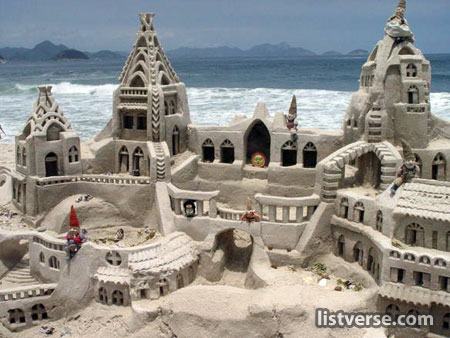
The more that I search for art throughout the year, the more I realize that there are an extremely wide variety of art forms that are transient. The majority of art that we encounter, particularly as a child, is temporary art.
Costumes for Halloween are perfect examples of temporary art. People spend hours, even days preparing their Halloween costumes, and sometimes there is not even a record of this costume a few days later. Another example directly relating to Halloween is pumpkin carving. This is an interesting art form that most people have taken part in, but there are a number of experts who make extremely complex art out of a pumpkin. Yet, no matter how impressive the art, it can at best be saved through photography.
Another form of temporary art that we encounter as children is the making of sandcastles. Almost every child at one point tries to make the most impressive sand castle they can at the beach, and they try their best to fend off the ocean as the tide rises, but no matter what, the sand castle is not preserved through the next day. In addition, much like pumpkin carving, their are expert "sand sculptors" but their art can also only be preserved through photography.
Costumes for Halloween are perfect examples of temporary art. People spend hours, even days preparing their Halloween costumes, and sometimes there is not even a record of this costume a few days later. Another example directly relating to Halloween is pumpkin carving. This is an interesting art form that most people have taken part in, but there are a number of experts who make extremely complex art out of a pumpkin. Yet, no matter how impressive the art, it can at best be saved through photography.
Another form of temporary art that we encounter as children is the making of sandcastles. Almost every child at one point tries to make the most impressive sand castle they can at the beach, and they try their best to fend off the ocean as the tide rises, but no matter what, the sand castle is not preserved through the next day. In addition, much like pumpkin carving, their are expert "sand sculptors" but their art can also only be preserved through photography.
Thursday, October 28, 2010
Visual Essay Presentation
This presentation was an interesting project. It was much different than a usual essay, however, that did not make it easier. Putting together photographs in the form of an essay is not a skill that I have ever used before. Creating a "story" with photographs is a complicated task, especially when we also have the task of developing our own topic, which can be any array of themes.
In addition to taking and arranging our own photographs, the presentation itself presented another task. This was the first presentation that I have ever done that required me to be extremely concise. It is usually the exact opposite, where as much information as possible is best. I realize that the method we used for this project is much more effective for both the audience and the presenter. It forces the presenter to chose there words carefully, and make sure their points are concise, this also allows for the audience to be less likely to lose interest in the presentation.
There were also a number of themes that I had not even considered when I was choosing my theme. Themes like, steps, benches, lampposts, or the contrasts of art and its effect on us. These different themes gave me a different perspective on public art. The concise nature of the presentations also made it much easier to understand the core of the theme, and make it interesting.
In addition to taking and arranging our own photographs, the presentation itself presented another task. This was the first presentation that I have ever done that required me to be extremely concise. It is usually the exact opposite, where as much information as possible is best. I realize that the method we used for this project is much more effective for both the audience and the presenter. It forces the presenter to chose there words carefully, and make sure their points are concise, this also allows for the audience to be less likely to lose interest in the presentation.
There were also a number of themes that I had not even considered when I was choosing my theme. Themes like, steps, benches, lampposts, or the contrasts of art and its effect on us. These different themes gave me a different perspective on public art. The concise nature of the presentations also made it much easier to understand the core of the theme, and make it interesting.
Tuesday, October 19, 2010
Coffee Art
I found this video on youtube the other day. It is a very interesting concept: combining cream with a latte, and sometimes chocolate, to create images in the cup of coffee. This is both an interesting example of food art, and temporary art. I believe that it bears a relation to the sand mandalas, in a much less impressive and meaningful sense, but still at the core is impermanent art.
This, as well as the sand mandalas, are examples of how art reproduction allows others to view art that only a select few would normally be able to see. In addition, the filming of the creation of this art is almost as interesting as the result. The quick, fluidity of this coffee art makes it interesting, and surprising to see the result, whereas the sand mandalas are viewed generally in a time lapse because of the painstaking effort that goes behind the placement of single grains of sand.
Washington: a city of public art
Washington D.C. is a city that, I believe, has one of the largest collections of public art in the United States, as well as some of the most impressive. In terms of the reasoning for the creation of this public art, the majority of it was created in memory of an individual, such as a president, or a group of individuals, such as soldiers. Having been to the city myself, I believe that the public art vital to the city, and it's abundance at our nation's capital inspires nationalism to visitors from around the country.
Tuesday, October 12, 2010
Visual Essay - Public Art
When I started looking for pictures for the project. I was initially frustrated because I could not find anything that I myself would normally call "art." As I broadened my view of art, I decided on the idea that there are pieces of public art that we use everyday, and just do not think of as public art. Like we read in class, public art can be considered anything that is not in a museum or a gallery. Things like street signs are designed in a creative way that makes them practical. Things like bench swings at the park, or even fire hydrants can be "sculptures" of public art. That is why I have decided on my theme for the project to be: Practical Public Art. Basically, public art that we use everyday, and do not normally consider art, even though they have artistic value.
Wednesday, October 6, 2010
Art's effect on the world - War of the Worlds
As discussed in the Mirzoeff reading, art can have a profound effect on the world, especially in terms of politics, and "truth." Through the example of the Serbian news cast, and the CNN news cast, the "truth" of the broadcast came into question, and the mere inclusion of the CNN logo convinced many that the video must be the truth.
An extreme example of people believing news sources too readily is when Orson Welles read an adaptation of the book The War of the Worlds by H.G. Wells on a radio broadcast. This happened on a radio station in 1938, and caused widespread panic. People heard the accounts of the martians invading the earth, and people called the police, and some fled. Most of the listeners did not here the portions of the program where it was said that this was a story, and many of them believed whatever was on the radio.
This is an example of how art had a direct influence on people, and their actions. Much like the case with the Serbian and CNN stations, too many people believed whatever they heard on the radio. However, now, what types of news should we trust? And what types should we question?
http://history1900s.about.com/od/1930s/a/warofworlds.htm
Tuesday, October 5, 2010
The Art of Horror
I was watching the Halloween remake by Rob Zombie last night, and as I was watching it, I realized the other dimension of horror films that make them interesting. Horror movies are designed to make you have a specific reaction to them, fear. Unlike certain paintings that we have discussed, which can have varying reactions, horror films have one basic aim.
On a basic level, all horror films are trying to make your body feel so much fear that your heart rate increases, and your body responds with the "fight or flight" mechanism, releasing adrenaline, and causing some people to scream. One characteristic of a good horror film is the ability to not only give you a window to another world, but also bring you into the world, and convince your brain that it IS real.
This is an interesting concept, because everyone knows that your T.V. cannot physically harm you (in most cases), yet our body reacts to horror films as if there is an imminent physical danger. This phenomenon seems to be created through an easing of our minds into the world of the movie. This allows for the context of the film to dictate our primal reactions, and if the filmmaker is talented, draw us into the world completely.
Much like some paintings we have viewed, horror films require complete attention for them to take their full effect on us. If our minds slip out of the "reality" created by the film, the effects of the movie are lessened, or non-existent. However, if we turn off all the lights, and watch a horror film by ourselves, we are much more likely to feel the full effect of the movie, and become engrossed in the movie's "reality."
Sunday, October 3, 2010
M.C. Escher
I know a number of other people have been posting about optical illusions as art, and I thought I would contribute. M.C. Escher was a dutch artist who was known for his strange patterns, and architecture in his art that was impossible. When I was in 6th grade, I went on a field trip to see his work, and this was the first time I had ever heard of him. His work interested me, because instead of the conventional artist who portrayed, and explored emotions in their work, Escher explored the limits of visual computation by bending the laws of physics, and reality with his artwork. Some of his most famous works include:

Drawing Hands

Relativity

and Hand With Reflecting Sphere.
I find Escher's works to be unique, and extremely interesting. They require complete attention, and really work your mind as you think about them in the context of the real world.
Drawing Hands
Relativity

and Hand With Reflecting Sphere.
I find Escher's works to be unique, and extremely interesting. They require complete attention, and really work your mind as you think about them in the context of the real world.
Thursday, September 30, 2010
Dynamic Art-Video
This is the only name I can think of to give this sort of art. This video shows an interesting approach to the idea of a canvas, and constantly changing the art as it is being made. The process of the creation of this art may be the most important part. I believe this is a combination of painting, and video art. It is nothing like I have seen before.
http://www.youtube.com/watch?v=-ZoWHW4EnbM&p=FF8498DD361F23E1&playnext=1&index=3
Wednesday, September 22, 2010
Sand Mandalas
http://www.youtube.com/watch?v=g-H0TlXi868
Sand Mandalas are a religious work of art made by buddhist monks. It is made entirely out of colored sand. The image generally contains religious themes and symbols. At times, even single grains of sand are carefully placed on the work. The most interesting part of the process is that at the end of the days, or weeks of work on the art, when it is finally finished, it is destroyed to symbolize the impermanence of life. This is a very interesting form of art that can usually only be viewed through photo reproduction for most people.
Tuesday, September 21, 2010
Tattoos: An Unconventional Medium
Tattoos have been around for hundreds of years, and been used for a wide variety of purposes. They have been used for religious and tribal reasons, and now they are available to everyone. Just as there are highly skilled, and world renowned painters, there are also world renowned tattoo artists. The interesting thing about tattoos is that the average person can commission this type of artist to create a work of art, but instead of canvas, the body is used. This allows for an interesting, and one of a kind art work that has much more of an effect in person, than through the reproduction of a photograph. The other interesting thing about tattoos as compared to other mediums, is that the owner remains the same throughout the owner's life, but then the art is lost at the end of the owner's life.
Wednesday, September 15, 2010
The "Aura" of Music
Music, much like any other art, has an "aura" about it when seen in person. I believe this aura is much easier to perceive to the common person than is the aura created by visual art. There is a clear presence created by high profile musicians. The interesting thing about this aura in music and in painting is that a lot of the aura is created by the media, and indirect contact with the medium. For example, the Mona Lisa is an incredibly famous and "mystified" painting, but it is arguable that this painting would not be nearly as famous without reproductions of it spread throughout the world; this is the same with music. Musicians are established by their recordings which are experienced by listeners, and then the live performance is even more special because people know about the musician, and the performance puts you face to face with something that was merely an aural experience before, creating the surreal "aura" experience.
Monday, September 13, 2010
Art Without a Cause
I believe that a lot of art is overanalyzed. As we have discussed in class, some art is merely "mystified" because of the media's attention, and we ourselves try to find the "secret" meaning behind it. I believe that it is very possible that a number of great and famous paintings may have been the result of an expanded "doodle" or a drawing that they may have mindlessly made, and perfected into greatness. This is to say that not all art has a secret, and deep meaning or inspiration behind it. My friend Alex Lievens is an artist who has made a number of great drawings, while in class nonetheless, and they all look amazing, but they do not have a deeply rooted meaning behind them, yet without a cause for its creation, this art, is still art.


All of these drawings were made by and are property of Alex Lievens.
Wednesday, September 8, 2010
Foucault, Las Meninas
Foucault initially talks about the painter portrayed in the painting. This painter appears to be painting a picture of the viewer of the painting. Foucault goes into much more detail with a sort of paradoxical rant about viewing the invisible, yet this is interesting because of the idea that we are looking at a fictitious painter who is painting something that is invisible. Foucault goes on to talk about the mirror that is present, and glowing in the center of the painting. It is thought that in this mirror, King Philip IV and his wife are portrayed. This is thought to potentially be the subject for the painted painter.
All of the information in this essay is very interesting and thought provoking. I look at the painting in an entirely different way after reading the essay, different from my first glance at the painting, when I thought I had seen everything.
Tuesday, September 7, 2010
Artists and Media Attention
Who would you think this painting is by? Monet? Renoir? No, this painting is actually by a small, 8 year old boy from Britain named Kieron Williamson. This is one of his paintings called "Windmill at Sunset." There is an article about him here: http://www.artdaily.com/index.asp?int_sec=2&int_new=39932.
This is similar to what we have been discussing in class about how media attention can create a huge amount of interest in certain paintings, or artists. One of Kieron's paintings sold for about $235,000. This brings up the question of whether it is the value and meaning of the painting that warranted this price, or was it the fact that the artist was 8 years old? It is interesting because, now, the media has created a sort of "snowballing effect" where the media attention to Kieron is compounded by the expensive purchases of his works, creating an increasing "mystification" surrounding him. Whether or not Kieron's fame and success will follow him into adulthood is unknown. It also remains to be seen if Kieron even wishes to continue painting into adulthood.
Wednesday, September 1, 2010
Reflection on Against Interpretation by Sontag
After reading "Against Interpretation" by Susan Sontag, I had a few opinions of my own on the issue. There are a large number of very valid points brought up in this essay, including the idea that art has no meaning without interpretation and that the content of art has a large effect on our opinions of it, in addition to our interpretation of it.
In my opinion, art truly does not have any meaning without interpretation. The only reason we could possibly enjoy/like any kind of art, other than it's "mystification" brought upon by popular media, is the fact that we can relate directly with it, and this requires a degree of interpretation. Very few works of art, paintings in particular, have a clear cut meaning. This ambiguity that the artist creates allows us to fill in the gaps and make it pertain directly to us, where, in some cases, we feel as if we can sense the artist's true intentions. This ambiguity is a sort of "puzzle" that has no specific answer, except to the individual who interprets it. As is said by Nietzsche in the essay "There are no facts, only interpretations."

The Mona Lisa has been subject a wide variety of interpretation throughout its existence, and yet, no one truly knows the true "secrets" behind it, if there are any at all.
Another topic brought up in the essay is the idea that the role of content in art has changed over time. The essay brings up the idea that a work of art used to be defined through its content, yet it also addresses the idea that content can not even appear in some art. Abstract art can arguably address an emotion or idea without the use of direct content, however complex ideas cannot be expressed through the use of abstract art, I believe that it is easiest to express the emotion of anger through abstract art, but only in the feeling's most raw form.
In my opinion, art truly does not have any meaning without interpretation. The only reason we could possibly enjoy/like any kind of art, other than it's "mystification" brought upon by popular media, is the fact that we can relate directly with it, and this requires a degree of interpretation. Very few works of art, paintings in particular, have a clear cut meaning. This ambiguity that the artist creates allows us to fill in the gaps and make it pertain directly to us, where, in some cases, we feel as if we can sense the artist's true intentions. This ambiguity is a sort of "puzzle" that has no specific answer, except to the individual who interprets it. As is said by Nietzsche in the essay "There are no facts, only interpretations."
The Mona Lisa has been subject a wide variety of interpretation throughout its existence, and yet, no one truly knows the true "secrets" behind it, if there are any at all.
Another topic brought up in the essay is the idea that the role of content in art has changed over time. The essay brings up the idea that a work of art used to be defined through its content, yet it also addresses the idea that content can not even appear in some art. Abstract art can arguably address an emotion or idea without the use of direct content, however complex ideas cannot be expressed through the use of abstract art, I believe that it is easiest to express the emotion of anger through abstract art, but only in the feeling's most raw form.
Sunday, August 29, 2010
First Visit to High Museum
I visited the High Museum of art today for the first time. There were a number of exhibits on display, including Dali and European Design. The exhibit I enjoyed most was that of Salvador Dali. Dali was a spanish surrealist painter that used quite a bit of symbolism in his paintings. To my knowledge, the collection currently at the museum is comprised mostly of his later works. Possibly his most well known painting, "The Persistence of Memory", was not in this collection:

The Persistence of Memory
I found it very interesting that Dali employed a technique where he would paint a number of seemingly disconnected shapes, yet through further examination, it can be seen that these shapes were all part of a bigger picture:

This Painting is called "Fifty Abstract Paintings Which as Seen from Two Yards Change into Three Lenins Masquerading as Chinese and as Seen from Six Yards Appear as the Head of a Royal Bengal Tiger." With a very descriptive title, this painting must be seen in person for the desired effect. This piece is one of many that Dali made which requires a significant amount of time to see the desired effect. All in all, my first visit to the High Museum was much better than I had initially anticipated, I particularly enjoyed the surrealist art, and hope to see more art like it later on.
The Persistence of Memory
I found it very interesting that Dali employed a technique where he would paint a number of seemingly disconnected shapes, yet through further examination, it can be seen that these shapes were all part of a bigger picture:
This Painting is called "Fifty Abstract Paintings Which as Seen from Two Yards Change into Three Lenins Masquerading as Chinese and as Seen from Six Yards Appear as the Head of a Royal Bengal Tiger." With a very descriptive title, this painting must be seen in person for the desired effect. This piece is one of many that Dali made which requires a significant amount of time to see the desired effect. All in all, my first visit to the High Museum was much better than I had initially anticipated, I particularly enjoyed the surrealist art, and hope to see more art like it later on.
Thursday, August 26, 2010
Definition of art
This is what I would call a clear definition of art. This painting was done entirely with lipstick, not paint. The use of lipstick is ironic because Angelina Jolie has coveted lips. The main reason I would call this a definition of art is because it uses an unusual medium and technique, where traditional “technique” is irrelevant in the idea or emotion conveyed. What better way to capture Angelina Jolie’s lips than to paint with lipstick? The making of this piece can be seen at http://www.youtube.com/watch?v=r-dRZ3TJbok&feature=channel.
Subscribe to:
Posts (Atom)